Reflections from the Revised Common Lectionary Texts
Showing posts with label Year A. Show all posts

November 13, 2011

Christ the King A: Becoming the Body of Christ

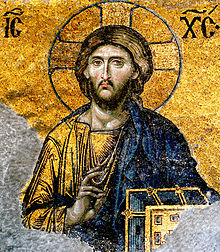
Christ Pantocrator mosaic
Daphni, Greece (ca. 1080-1100)
OLD TESTAMENT:  Ezekiel 34: 11-16, 20-24
The oracles of Ezekiel are often downright alarming to us.  The writer’s understanding of God often seems to us to depict a powerful and sometimes scary Holy One upon a high and mighty throne that judges and hands out punishment because of the sins of the people, so a little history would probably help us out a little.  First of all, the prophet Ezekiel was probably part of the group of those who were deported from Jerusalem to Babylon in the year 597 BCE.  So his ministry was to those who were in exile with him.  He used visions to give them hope, to remind them that God was present even in the exile with them.  But he also proclaimed that the loss of the temple and the exile was the people’s fault, rather than God’s, that the circumstances in which they now found themselves were consequences of what they had done and how they had acted.  They had heard God but had not taken God’s Word seriously.  He condemned the leaders for being irresponsible shepherds of the people and for their lack of justice toward those in their care.
So, this reading focuses on restoration.  Using the image of the shepherd, the writer depicts God as the One who will take over and rescue the sheep.  It depicts a Great Gathering.  God as the Shepherd seeks each one out and brings them to good pasture, green and lush and plenty.  The metaphor of the shepherd is a common one in the ancient Near East.  It is a metaphor not of passivity or weakness, but of a power defined by justice and compassion, which is why this reading works well for our Christ the King readings.  After the promise of new leadership, God promises a new covenant of peace.
If you read it, though, this is not necessarily an indictment but rather a condemning of the behavior of the unjust leaders (and possibly of the people themselves for following those who were not good and just!)  So God will step in.  In other words, hope is never lost.  We read the words “I will save my flock.”  There is talk of judgment, of justification, but over and above, God saves.  This is not carrying any of those so-called “hellfire and brimstone” images but rather the image of One who dispenses justice and discipline. This is not, contrary to what some would think, a God of wrath but, rather, a God of Righteousness, a God of Justice, a God of Light, lighting the way for those in darkness and shining a light on those who inflict the darkness.  But when it is all said and done, God will transform all into the flock of this righteous and just Shepherd, where they will be fed and nurtured, and live in peace.  It is the vision of the Peaceable Kingdom.  It is the vision of God.
We read this as part of our Christ the King Lection because it is a different view of the King.  The King is a Shepherd (and the Shepherd is a King).  This is not a King who rules in wrath and dispenses punishment but rather a King who rules in righteousness and dispenses justice.  And, more than that, this is a God who seeks and searches until the flock is found.  And when God starts dividing the flock, it’s not into “good and bad”, “right and wrong”, “us and them”.  Rather, it is bringing strength to the weak, healing to the injured, and “foundness” to the lost.  Any division that happens is so that God’s grace can permeate and save us all.       

a.      What is your response to this passage?
b.      What is it about some of these visions that bother us so much?
c.       What image of the Peaceable Kingdom does this passage depict?
d.      Why do we insist on dividing God’s Kingdom into “us” and “them”?


NEW TESTAMENT:  Ephesians 1: 15-23
Most scholars agree that Ephesians is considered what you could call a “Deutero-Pauline” work, implying that it is “second” or “secondary”.  (This would also refer to 2 Thessalonians and Colossians).  These letters were probably written in the 70’s or 80’s.  Paul more than likely died around 60, sometime around Nero’s reign.  So, rather than being written by Paul himself, Ephesians was more than likely written by a follower of Paul, using the format and even the style that Paul employed in his letters.  This is not plagiarism.  In that society, placing someone else’s name on a work was considered the highest form of compliment.
The main purpose of Ephesians, probably written to a Gentile audience, seems to be to remind the believers of their communal identity in their new status in Christ and to urge them to walk in ways that demonstrate this communal identity and unity.  (When you think of it, this idea of “community” would probably have been more difficult for Gentiles to grasp than for the Jews of that time, who had a sense of community embedded in their very being.)  The church here is understood as a Body of Christ that is exalted, which resonates with our understanding of the community of saints here and forever.
In this week’s reading (which is actually made up of four run-on sentences for all you English writing aficionados!), the writer describes Christ’s Reign as having by established by God’s power in the work, death, Resurrection, and spirit of Christ.  It is not a matter of placing Christ as King over other Kings.  This is not some calculated hierarchy of authority.  Rather, Christ is King…Period.  There is no other.  And this Reign of Christ IS the fullness of the Kingdom of God, when peace and justice and righteousness will finally be securely in place.  Dietrich Bonhoeffer wrote that “nothing is lost…everything is taken up in Christ, rid of evil, and remade.  Christ restores all this as God originally intended to be—without the distortion resulting from our sins.”  (Dietrich Bonhoeffer, Letters and Papers from Prison, as quoted by Jennifer M. McBride in Feasting on the Word.)  
In verse 18, “the riches of the glorious inheritance of the saints” refers to that inheritance that is extended through Christ who God raised from the dead, caused to sit in “heavenly places”, and gave authority over all things.  We are part of this inheritance.  But the reading does not end with the Kingship of Christ as one that is removed from us or one that is “out there” for us to inherit.  The reading instead closes with a reference to the church as the Body of Christ that is triumphant in all things, the point of eschatological fulfillment.  In other words, the Body of Christ is us.
There’s this huge poster way up on the wall of one of the meeting rooms at Lakeview, our Texas Conference assembly and retreat center.  If you look at it closely, you saw all these wonderful different pictures of people in ministry, doing what God called them to do.  But if you step back far enough, you realize that together the pictures form a silhouetted image of Jesus.  The point is that it takes all the pictures finally coming into being, coming into focus, and fitting with each other the way a jigsaw puzzle does, to realize that image of Christ, that Vision of God.
In this week when we celebrate the Reign of Christ, we are given a tiny glimpse of that vision that will be.  But unlike earthly kings and queens that we crown and just sit back to see what they do, the crowning of Christ as King comes one picture at a time.  What picture is yours?  What part of this vision has God called you by name to bring?  What were you created to be?

a.      What message does this reading hold for you?
b.      What image of the Reign of Christ does this reading give you?
c.       What does it mean for you to have this “inheritance”?
d.      So, what does it mean for us to BE the Body of Christ?
e.      What part of this vision is ours to build?


GOSPEL:  Matthew 25: 31-46
This passage probably makes all of us a little uncomfortable.  We’ve gotten to know this welcoming, nurturing Jesus and here, just before we read of the conspiracy to arrest Jesus in the next chapter, just before the beginning of the end, we get this.  First, we get a depiction of the Son of Man coming in all his glory.  It reflects the imagery of Daniel (-14) and foretells the coming judgment.  The image seems to be a little scary.  From the throne, the King uses his authority to separate individuals like sheep and goats.  And we are told that the sheep will inherit the kingdom.  So what happens to the goats?
The issues of the final judgment and the establishment of God’s Reign were of paramount importance to the writer of Matthew’s version of the Gospel.  (So keep in mind that it’s not clear if these things were on the top of Jesus’ list!  In fact, there are some theologians that think that this prophetic writing was added to the end of the string of parables that came before it.)  I mean, think of all the ways that Jesus talked about salvation and the Kingdom.  None of them included a list of who was “in” and who was “out”.  Jesus seemed to be more concerned with showing everyone the way home.
The judgment is not based merely on doing the right thing.  In fact, both those who had done what was good and honorable and those who had not actually had the same response.  (When was that, Lord?)  That’s pretty cool.  Those who were doing the “right things” still had doubts, still had questions, still walked in faith.  But they loved their neighbor.  It was an authentic outpouring of the love of God.  Apparently, that’s what it’s all about.
But this is not a checklist of things to do so that you can go to heaven or whatever your vision of eternal life is.  This is depicting a way of living, a way of being.  This is depicting the Kingdom of God.  And getting signed on to the sheep team is not about us.  It is about loving our neighbor.  It is about being Christ in the world.  It is easy to read this and look upon salvation as something that we achieve.  But salvation is discovered (and sometimes in ways that we do not expect.)  And perhaps this writing is nothing more than a reminder of what it means to walk in the Way of Christ.  It means to love God and love neighbor.  The two cannot be separated.  As Christians (and as good Methodists), we usually default on the side of grace.  So, again, what happens to the goats?
About a week or so ago, NPR’s “Fresh Air” broadcast had an interview with Mark Derr, a naturalist who recently wrote How the Dog Became the Dog—From Wolves to our Best Friends.  In his book, Derr explores how the relationship between humans and wolves developed, and how that relationship then influenced the physical evolution of wolves into dogs.  He says that he believes that humans and wolves developed a close relationship after recognizing themselves in each other while hunting.  So, he surmises, the dog is a creation of wolves and humans—of two equal beings that came together at a certain point in history and have been together ever since.  As time went on, the physical features of the wolf began to change.  It’s skeletal frame became smaller and its jaw shortened.  In essence, the wolf became a dog by becoming a little more like its human companions.  So, maybe we’re all a bunch of goats.  Maybe the point is to become a sheep by taking on more human characteristics, by following in the way of the one who was fully human and fully divine.
We stand in a threshold between two times.  The Kingdom of God has both already and not yet begun.  We are given glimpses of what will be, but there is still much work to be done.  In Creation, God gave the gift of the very essence of God.  God spoke Creation into being and called we humans to be the very image of the Godself, full of love and compassion and righteousness and a hunger for justice and peace.  In Feasting on the Word, Lindsay P. Armstrong depicts this passage as a “wellness check and possibly even a warning to those living in unhealthy, self-centered ways.”  He says that “we may not like warnings or wellness checks; after all, they ask us to recalibrate our lives.  However, they provide a critical wellness overview that we are wise to tend, particularly since heart trouble plagues us all.”
We do not do what we do as Christians to gain salvation.  Being Christian means loving God and loving neighbor.  It means being who God meant for you to be, the very image of the Godself, in the deepest part of your being.  It means becoming a sheep and realizing that it’s about more than you and all the other goats on your team.  It’s about the Shepherd; it’s about following Christ; it’s about being the Body of Christ in the world.
This week’s Gospel passage depicts what it means to live into the fullness of this glory—feeding where there is hunger, bringing water where there is thirst, providing clothing, and help, and companionship to those in need, and welcoming every stranger into our midst.  It is that ever widening circle bringing everyone into the center and it gives us that sacramental vision to which we are called—“when justice shall roll down like waters and righteous like an ever-flowing stream, when nation shall not lift up sword against nation, neither shall they learn war anymore.”  Rosabeth Kanter said that “a vision is not just a picture of what could be; it is an appeal to our better selves, a call to become something more.”  

a.      What meaning does this passage hold for you?
b.      What is so bothersome about this passage?
c.       How would we fare in our “wellness check”?
d.      What depiction does this provide for us of that Peaceable Kingdom?


Some Quotes for Further Reflection:

The marvelous vision of the peaceable Kingdom, in which all violence has been overcome and all men, women, and children live in loving unity with nature, calls for its realization in our day-to-day lives. Instead of being an escapist dream, it challenges us to anticipate what it promises. Every time we forgive our neighbor, every time we make a child smile, every time we show compassion to a suffering person, every time we arrange a bouquet of flowers, offer care to tame or wild animals, prevent pollution, create beauty in our homes and gardens, and work for peace and justice among peoples and nations we are making the vision come true. (Henri J.M. Nouwen, Bread for the Journey)

Jesus didn't come to make us Christian; Jesus came to make us fully human. (Hans Rookmaaker)

The future enters into us in order to transform itself in us, long before it happens.  (Rainer Maria Rilke) 


Closing

To your table you bid us come.  You have set the places, you have poured the wine, and there is always room, you say, for one more.  And so we come. 
From the streets and from the alleys we come. 
From the deserts and from the hills we come. 
From the ravages of poverty and from the palaces of privilege we come. 
Running, limping, carried, we come. 
We are bloodied with our wars, we are wearied with our wounds, we carry our dead within us, and we reckon with their ghosts. 
We hold the seeds of healing, we dream of a new creation, we know the things that make for peace, and we struggle to give them wings. 
And yet, to your table, we come. 
Hungering for your bread, we come;
thirsting for your wine, we come;
singing your song in every language, speaking your name in every tongue, in conflict and in communion, in discord and in desire, we come.
O God of Wisdom, we come.  Amen.

                                                                        (Jan L. Richardson, In Wisdom’s Path, # 129)

November 6, 2011

Proper 28A, Ordinary 33A: Response

OLD TESTAMENT:  Judges 4: 1-7
The Book of Judges portrays a major transition in the Biblical history of Israel.  Prior to this, Israel was under the leadership of Moses in the wilderness and then Joshua in the conquest of the land in Canaan.  After the Book of Judges, Israel was ruled by kings, beginning with Saul, David, and Solomon.  This is the time in between, a time of twelve warrior rulers, called judges, who led Israel for brief periods in times of military emergency.  Most scholars think that many of these passages do not represent true accounts but have rather been reshaped and edited (redacted) and so cannot be necessarily reconstructed into a succinct historical account.
"Deborah Beneath the Palm Tree"
(James Jacques Joseph Tissot,
c. 1896-1902), now housed at
the Jewish Museum, N.Y. City, NY
This passage begins with the first phase of the story of the beginning of the decline of Israel and the decline in the effectiveness of the individual rulers.  The repeating pattern throughout judges is present here: (1) The Israelites do evil, (2) The Lord turns them over to their enemy, (3) Israel cries out to the Lord, and (4) The Lord raises up a new judge who delivers them (for a period of time).  We are not really clear here who the actual judge is.  The three characters here are Deborah, who is a female prophetess who acts as a sort of arbitrating judge, Barak, a military general, and Jael, a non-Israelite woman who kills the enemy Canaanite general Sisera when he comes to her tent for refuge.  The Jewish legends depict Sisera as a giant of a man who could destroy the walls of an enemy’s city with a single shout.  In some ways, it is another “David and Goliath” story.  Enter Deborah…sitting under her palm tree proclaiming words of wisdom, she calls Barak, an experienced military general (but probably nothing like the great Sisera!).  And she calls him to go against this great army. 
Interestingly enough, the Book of Judges contains the largest number of female characters of any book in the Bible—nineteen in all.  But Deborah is probably looked upon as at least one of the most influential female leaders in the Old Testament if not in the whole Bible.  It is actually a little unclear whether the “wife of Lappidoth” reference was referring to the name of her husband or if it means that she was “fiery” or “spirited”.  It could be either.  Regardless, though, nothing is said about her husband if there was one.  So Deborah is depicted as strong and level-headed, a true leader who advised generals and led troops into battle.  In a day when woman were considered property or chattle, when women did not speak and it was assumed they had nothing to say, when women were only there to produce children and heirs, Deborah stepped forward and led.
Deborah is often depicted as sitting under a palm—just sitting.  Perhaps that is as powerful a statement as the fact that she advised generals and led troops into battle.  Maybe that was her way of centering, of filling her life with much-needed peace.  Maybe sitting was the way she gained inner strength to do what needed to be done.  Maybe she was in prayer.  It doesn’t really say.  She just sat. 
I don’t think that this story is meant to compel us to focus on one hero.  After all, Deborah called Barak to lead and he led armies defending Israel against Sisera’s troops.  And Jael drove the peg into Sisera’s temple.  They all worked together.  This passage shows that God can work through even complex power systems with multiple leaders.  God does not command one system or structure.  God’s grace is always at work.  So, if you’re looking for a hero, maybe God is the one.
We don’t read it as part of this lection, but Judges 5 includes what we call the “Song of Deborah”.  It is a song of remembrance of what God had done through these rather unlikely people, a reminder that things don’t always go as expected, and a reminder that violence is never the ending.  Violence is still part of us today.  Surely God does not call us to violence.  Is there a way to use it for good? 

a.      What is your response to this passage?
b.      How do you see God at work in this passage?
c.       In what ways do you see God at work in the midst of our own social and political circumstances?
d.      What significance does the depiction of Deborah “just sitting” mean for you?
e.      Do you think that it is ever possible to use violence for good, to turn it around into something else?


NEW TESTAMENT:  1 Thessalonians 5: 1-11
The Thessalonian letters are witnesses to the church’s struggle with the sufferings of its members, due to separation from leaders, alienation from friends and family, and threats of persecution and even death.  The passage that we read speaks, obviously, of the coming “Day of the Lord”.  Here, Paul claims that on this Day of the Lord, God will separate the believers from the unbelievers and for this reason, the believers can celebrate even now.  But Paul continues to claim that the full consummation of the new age has not occurred and that, for this reason, believers must continue to be vigilante in the faith.
I don’t think that this is as much a “hold on, Friday’s coming”, as it is a reminder to not let the mire of difficulties and defeat get in the way of one’s true calling—the pursuit of holiness.  In fact, rather than letting them get you down, perhaps they are part of that journey itself.  And on that journey, we are called to encourage each other and help each other.  After all, we are “children of the light”.
Much of this same imagery has been used in songs (such as the “Battle Hymn of the Republic”) and in a lot of slave songs, describing a future hope even in the face of darkness and persecution.  The images here are apocalyptic.  They are visions and revelations that remind us that our future is secure in the life, death, and resurrection of Christ.  The future coming of the Lord is not something to be feared.  It is now.  Rather than living in fear of what is to come, we are called to live in hopeful expectation for the glorious Kingdom that is breaking into our lives even as we speak.  The “Day of the Lord” is now.  Paul is not holding out something in the future but is instead trying to depict what a life pursuing holiness really looks like.
In Feasting on the Word, John E. Cole says that Jurgen Moltmann “declares that the coming of God should make believers “impatient” with the way the world is today.”  That’s probably what Paul was trying to depict.  He was not trying to scare people into repentance (in spite of what some modern-day tele-evangelists declare!); rather, he was trying to get them to see a different way and want it so badly, hold to it so tightly in hopeful expectation, that they could do nothing else but live into it, that they could do nothing else but walk in holiness. 

a.      What meaning does this passage hold for you?
b.      Why are these images sometimes uncomfortable for us?
c.       What changes when you look upon them as “hopeful expectation” rather than fear?
d.      What would it mean for us to want God’s vision to come to fulfillment so badly that we could do nothing else?


GOSPEL:  Matthew 25: 14-30
The passage that we read is the familiar “Parable of the Talents.”  Here, though, a “talent” is a monetary unit.  Yes, my friends, here Jesus is talking about money.  Did you know that if we took all of Jesus’ teachings about money out of the Gospels, we would reduce them by more than one third?  Did you know that sixteen of the thirty-eight parables attributed to Jesus are about money?  Did you know that one of every seven verses in the first three Gospels in some way deals with money?  In fact, Jesus spoke more often about money than about any other subject except the Kingdom of God itself?  Now, my take on this is not that money is more important than other things.  My take on it is that even in first-century society, money and people’s view of money was a problem—not because it’s bad or evil, but because it is so easy for we humans to fall into the trap of letting it reshape our lives into something that it’s not supposed to be, allowing it to rise to the top of our view, clouding our judgment, getting in the way of how we see each other, and somehow convincing ourselves that there is never enough to go around.
And in this parable, Jesus reminds us that, whether or not we receive equal shares of Creation’s bounty, God entrusts all of the resources that we have at our disposal to us.  And, as stewards of these resources, we are called not to hoard them, not to let a fear of scarcity dig holes in our lives that we attempt to fill with material things, and not to let what we have deflect from the light we have been shown, pushing us out into the darkness.  We are, rather, called to a life of abundance, recognizing that everything that we have comes from God and is given to us to use in the building of the Kingdom of God.
But if we don’t talk about money, how will we know that?   Jesus knew this and he knew the difficulties that we have.  He knew that money and, specifically, the lack thereof, scares us.  But he also knew that if we lose perspective of our money as a God-given resource, as a God-shared part of Creation, as a God-entrusted tool that we are called to use to build the Kingdom brick by brick, talent by talent, and dollar by dollar, we would lose that image of the one that God is calling us to be.
How much more applicable could a passage be for us today?  We live in a world riddled with misuse of resources, saturated with greed, and filled with fear of what our economic future holds.  You don’t have to go any farther than the front page of the paper, your living room, or access to the internet to see how bad it is.  Apparently, what we need is a hero, of sorts.  (Where is that wise woman sitting under the palm tree when you need her?)  The truth is that the world around us probably makes this parable even more uncomfortable for us.  Well, it has often been said that if a parable does not make you a little uncomfortable, you have probably not gotten its point.  Several years ago at the height of our country’s economic collapse, CNN’s Anderson Cooper did a breakdown of the “top ten culprits of the collapse”—according to him the blame went to Congress, the White House, the banks, Goldman Sachs, Wall Street…I don’t know, I don’t remember the order.  The point is, it’s not important. Because, in case you missed it, the number one culprit in Anderson Cooper’s countdown was you; in other words, it was all of us.  And that third servant in the parable?  That’s the one that hits a little too close to home.  Thinking our voices too weak and our offering too meager, we are often guilty of burying those things that God has provided us.  We are guilty of being afraid to use what God has given us.  We instead hold onto what we think is “ours” a little too tightly until we literally suck the life out of it.
We do forget that everything that we have was God’s first and will be God’s when it is all said and done.  In that respect, we are middle managers, stewards of that which is God’s.  And the question then becomes, how do we as good managers invest God’s resources?  How do we use our time, our talents, and our money?  What do we do with those things with which God has entrusted us to further God’s kingdom?  That is the whole reason why we have been entrusted to be stewards of these things.  God knows that we are capable of getting it right, even if we haven’t yet convinced ourselves.  God has given us resources beyond what we can count; indeed we are dealing in what could be termed heroic measures and all we’ve been asked to do is to be who God calls us to be.
John Westerhoff defines stewardship as “nothing less than a complete life-style, a total accountability and responsibility before God.  Stewardship [he says] is what we do after we say we believe, that is, after we give our love, loyalty, and trust to God, from whom each and every aspect of our lives comes as a gift.  As members of God’s household, we are subject to God’s economy or stewardship, that is, God’s plan to reconcile the whole world and bring creation to its proper end.” (John H. Westerhoff, III, Building God’s People in a Materialistic Society (New York:  Seabury Press, 1983), 23, (as quoted by Ronald E. Vallet, Stepping Stones of the Steward (Grand Rapids: Eerdman’s Publishing, 1989), 2)  
So, being good managers of God’s economy means that all that God has given us is ours to use.  It means that everything that we are should be used for God’s glory—our prayers, our presence, our monetary gifts, and our time and talents—all are used as witnesses to who God is and what God is doing in the world.  Giving back of those resources, then, is something that we are indeed called to do.  But it is more than that.  It is an act of faith.  It is the way that we prayerfully and faithfully offer ourselves to God.  It is the way that we participate in the building of the Kingdom of God.  So, what part of the Kingdom is ours to build?  There…whatever you see is the part that is yours to build.  Martin Luther said that “I have held many things in my hands and I have lost them all.  But whatever I have placed in God’s hands, that I still possess.”
But, obviously, there is something here than money, something more than gifts.  The point is that everything is of God.  We are of God.  We are called to offer ourselves to God.  Our lives are lives of holiness.  What is God calling us to do?

a.      What meaning does this passage hold for you?
b.      Why are we so uncomfortable talking about money, especially in church?
c.       What message does this hold for our society in light of our current economic times?
d.      How are we called to “invest” God’s resources?
e.      What part of God’s Kingdom is yours to build?
f.        How does this passage speak to that “hopeful expectation” that we talked about before?


Some Quotes for Further Reflection:

Every noble life leaves its fiber interwoven forever in the work of the world.  (John Ruskin)

Try, with God's help, to perceive the connection—even physical and natural—which binds your labor with the building of the Kingdom of Heaven;  try to realize that heaven itself smiles upon you and, through your works, draws you to itself; then, as you leave church for the noisy streets, you will remain with only one feeling, that of continuing to immerse yourself in God.  (Pierre Teilhard de Chardin)

If my hands are fully occupied in holding on to something, I can neither give nor receive.  (Dorothee Soelle) 


Closing

Behold a broken world, we pray, where want and war increase, and grant us, Lord, in this our day, the ancient dream of peace.

A dream of swords to sickles bent, of spears to scythe and space, the weapons of our warfare spent, a world of peace remade.

Bring, Lord, your better world to birth, your kingdom, love’s domain, where peace with God, and peace on earth, and peace eternal reign.  Amen.

                                    (Timothy Dudley-Smith, The United Methodist Hymnal, # 426)

October 30, 2011

All-Saints A: Thin Places

This Sunday we are using the Lectionary readings for All-Saints so that means that we are actually “skipping” the readings for Proper 27A this year.  The Feast of All Saints is one of the major festivals of the church. In our United Methodist tradition, while we have specific readings for this day, they do change between the lectionary years (A, B, & C)  All-Saints Day (actually dated November 1st), probably dates back as far as 373, when the festival was mentioned in the writings of Ephrem Syrus.  The original emphasis was to honor the saints and martyrs who had no specific commemoration day.  As the festival transitioned to Protestantism (who obviously do not have the plethora of saints of our Roman Catholic and Orthodox brothers and sisters), it became a time of remembrance of those who had passed away in the last year. 

FIRST READING:  Revelation 7: 9-17
The Book of Revelation, which, despite its name, is the most veiled text of all in the Bible, makes great demands on those who read or hear it.  There is usually a temptation to move too quickly to interpret or translate its imagery into something that is more accessible and more easily understood.  To attempt to “decode” Revelation, as if it were Morse code, fails to take the medium that way it was given.  This is not a narrative.  It is not prophecy.  It offers instead a new view of reality.  Those with whom the Revelation was originally shared were much more comfortable with it and the mystery that it holds than we are.  There was not such a need to “prove” or to “figure out” every detailed meaning.  They were satisfied, rather, with the idea that God has been throughout history and will continue to be and that God has a greater vision of what is to come than any one of us can even attempt to imagine.  Isn’t that enough?
Albrecht Bengel was an eighteenth-century commentator, wrote this about Revelation: 
The whole structure of it breathes the art of God, comprising in the most finished compendium, things to come, many, various; near, intermediate, remote; the greatest, the least; terrible, comfortable; old, new; long, short; and these interwoven together, opposite, composite; relative to each other at a small, at a great distance; and therefore sometimes as it were disappearing, broken off, suspended, and afterwards unexpectedly and most seasonably appearing again.  In all its parts it has an admirable variety, with the most exact harmony, beautifully illustrated by those digressions which seem to interrupt it.  In this manner does it display the manifold wisdom of God shining in the economy of the church through so many ages.

In verse 4 (prior to this reading), the writer speaks of 144,000 from the children of Israel who are sealed.  (Just as an aside, this is where the traditions such as The Jehovah’s Witnesses get their number and their notion of “sealing”. But the number is thought to possibly refer to the twelve tribes of Israel times twelve times 1,000.  It connotes an infinite number.)  So, this is a much larger group, a great multitude.  They are identified and distinguished by their relationship with the Lamb.  Clothed in white, they hold palm branches (a symbol of victory) and they sing of salvation.  God is described as “hovering over them”, where God tabernacles and envelopes the people, as the Spirit hovers over Jesus at his baptism.  They are protected with a new freedom from hunger and thirst and the heat of the sun.  (Isaiah 25:8 is fulfilled)  Now this inclusive vision of the eschaton (the end) was a challenge to many late first century believers (when this was probably written) and it continues to be a challenge to many of us.  But these are meant to be words of encouragement.  They are meant to remind us of the ever-present God who walks with us through whatever comes and walks with us to whatever is waiting for us later in our journey.   And who knows?  God has surprised us with who has shown up at the banquet before!
The graciousness of God is evident.  The passage injects a theme of tenderness and comfort, and God’s sustaining promise of enduring witness to Christ in the midst of death and destruction.  The inclusiveness of the vision is striking (which is why it is used as a lection for All Saints Day.)  The multitude includes Jews and all those who have washed their robes in the blood of the Lamb, thereby identifying themselves with the way of the Lamb.
For us, our struggle with Revelation probably has more to do with the fact that we are trying to “figure it out”.  It’s probably meant to be symbolic metaphor and as metaphor it is contingent upon the context in which it was written.  We do not live in the late first century.  Even those of us who are well-versed historians can not appreciate the nuances that existed politically, emotionally, and even spiritually during that time for those who were living it.  We have never met John of Patmos, or whoever the writer was.  It’s a mystery.  But in that mystery, in these things that we do not understand, that do not make sense to us, we might have the gift of ever-so-slightly brushing up against the holy and the sacred and experience even a momentary glimpse of what is to come.  That’s all it is.  And whatever happens between now and when whatever is to come is revealed to us, the Book of Revelation tells us that God walks with us.  The Ancient Celts would have called it a “thin place”, a place where the distance between now and what is to come, between our “earth” and “heaven”, between the ordinary and the sacred becomes so thin that one can almost see through it; indeed, that it is only thinly veiled.  It is those times when one realizes that he or she is indeed on holy ground and that eternity stretches before us. Now we just need to not worry so much about figuring it out and get on with the journey!

a.      What does this passage mean for you?
b.      What image of God does this reading leave for you?
c.       What does the holy and the sacred mean to you?
d.      What are those “thin places” in your life?

Where is God in this picture?  God is all over the place.  God is up there, down here, inside my skin and out, God is the web, the energy, the space, the light—not captured in them, as if any of those concepts were more real than what unites them—but revealed in that singular and vast net of relationship that animates everything that is.  God is the web, the connection, the glue, the air between the molecules…As of God’s plan?  You know, whether God has a file I can break into and find out what I should be doing ten years from now?  The more I learn about chaos theory, the more I favor the concept of life with God as a dance instead of a blueprint.  God makes a move, humankind makes a move, then humankind makes a moved based on God’s move.  (From “Waltzing With the God of Chaos”, by Barbara Brown Taylor, in The Life of Meaning:  Reflections on Faith, Doubt, and Repairing the World, ed. by Bob Abernethy and William Bole, p. 47, 48)


NEW TESTAMENT:  1 John 3: 1-3
John Wesley said of the First Epistle of John, “How plain, how full, and how deep a compendium of genuine Christianity!”  Very little can be said with great confidence about the author of these three letters.  The First Epistle of John is written anonymously.  There is some similarity between these epistles and The Gospel According to John, but some point out that it lacks evidence of Semitic style characteristic of the Gospel and appears more “Greek” or Hellenistic in nature.  While most agree that 2 and 3 John are actually letters, the First Epistle of John is not as clear.  They really don’t know how to classify it.  It may even be some sort of commentary on the Gospel According to John itself.
The third chapter is part of a continuous expression of confidence in Christ’s coming.  It expresses a kinship in Christ, a relationship to God.  It encourages a present endurance as preparation for the future and a calling to become perfect in Christ.  There is clear evidence of God’s grace, bestowed freely and undeserved.  And, again, there is the reminder that we do not know everything about God, that we CANNOT know everything about God.  (I mean, really, would you want to?  Where would that leave God then?  Where would that leave our faith?)
There exists in this passage the notion that God’s presence and God’s love is both present and future, already realized and not yet revealed.  So which is it?  Yes…that is the point.  This is the Alpha and the Omega and everything in between.  It is the love that we know now and the love into which we are growing.  Again, don’t try to figure out which it is.  Just live it and live into it.  It has to do with who we are AND what we will be.  Those are not separate things.  In this passage, the writer reminds us that we are God’s children now and always.  God loves us and God wants to be with us.  The earth is God’s family.  We are all God’s children.  We are all growing into what we were created to be—the very image of God—pure and loving and holy.  And when we see that Love in which we were created and in which we live, then it all comes together.  THIS is the sacredness and the holy.  THIS is that wonderful “thin place” where we can see things the way they are meant to be seen.

a.      What does this passage mean for you?
b.      What does it say to you about that becoming perfect in Christ?
c.       So what are we called to know about God?


GOSPEL:  Matthew 5: 1-12
Well, this is the only Scripture this week that we have even a remote idea who the author is!  Most scholars agree that the core of what is known as the Beatitudes goes back to Jesus.  It is essentially a reversal of the usual value system that was in place in the first century.  The Beatitude was present in the Jewish tradition as a form of proclamation found in wisdom and prophetic writings.  They declare an objective reality as the result of a divine act.  Here, the opposite of “blessed” is not unhappy but cursed.
One thing to note is that the form of these Beatitudes use two verbs:  are and will.  Each beatitude begins in the present and moves to future tense.  They are, then expressions of what is already true in the Christian community not, necessarily, for individuals, but in community.  The move to the future tense indicates that the life of the kingdom must wait for ultimate validation until God finishes the new creation.  There is a resistance, then, against Christianity as a philosophy of life that would make one healthy, wealthy, and wise.  It is not a scheme to reduce stress, lose weight, advance one’s career, make one financially successful, or preserve one from illness.  It is, rather, a way of living based on the sure and firm hope that one walks in the way of God and that righteousness and peace will finally prevail.
In Year C of the Lectionary (which we looked at last year), the Lukan version of the Beatitudes are used. There are several differences in the two versions.  In Matthew (the more familiar one), there are nine beatitudes; in Luke, there are four.  The Matthean beatitudes are spoken from a mountain, probably since, as one writing to the Jewish community, this would depict that it was something important.  (Reminiscent of Moses on Mt. Sinai.)  The version told by the writer of Luke is spoken from a “level place” (sometimes called the Sermon on the Plain.  Matthew’s beatitudes are spoken to a “crowd”.  When Jesus speaks in the Lucan version, he speaks specifically to his disciples.  Matthew’s version has no corresponding “woes”.  In Luke, there are four “woes” corresponding to four “blessings”. 
Dietrich Bonhoeffer said this:  Humanly speaking, we could understand and interpret the Sermon on the Mount in a thousand different ways.  Jesus knows only one possibility:  simple surrender and obedience, not interpreting it or applying it, but doing and obeying it.  That is the only way to hear his word.  He does not mean that it is to be discussed as an ideal; he really means us to get on with it.
We read this in this week of All-Saints Sunday because it is about that New Creation that God has shown us.  It is a Creation that, again, is both already and not yet.  It has already begun and we are called to its work (to, as Bonhoeffer said, “get on with it”).  It is different from the things of this life—a Holy Reversal, of sorts.  And there is a future tense to it.  We walk in hope.  Blessing is just up ahead.  But blessing here is not meant to be something that we get as a reward for doing all these things.  As you know, God is much more nuanced than that.  It’s, rather, undeserved, unmerited.  Blessing is grace.  This is not God dangling some sort of treat in front of us to make sure that we run the right traps.  This is God revealing a vision of what will be—a life of comfort, abundance, mercy, and God’s ever-abiding Presence.  It’s what is here for us now and what we will always have.  We just have to learn to see things in a different way.  Once again, it’s about paradox.  We read it and we think we have it figured out.  In this world, “blessed” often means having wealth, or security, or ease of life.  It often means that things are going well.  But “blessedness” for Christ has nothing to do with the quality of this life at all.  It is about being one with God and one with others.  Perhaps being Christian, itself, is about being paradox, about looking at the world in a different way and being open to seeing things one has never seen before.  Perhaps being Christian is about daring to call oneself “blessed”.

                                                              i.      What does this passage mean for you?
                                                            ii.      What is the most difficult Beatitude for you to grasp?
                                                          iii.      How does this passage speak to our world today?
                                                          iv.      What does it mean to you to be “blessed”?
                                                            v.      Why do you think this passage is appropriate for our All-Saints reading?


Some Quotes for Further Reflection:

The future belongs to those who give the next generation reason for hope. (Pierre Teilhard de Chardin)

The saints are those who, in some partial way, embody—literally incarnate—the challenge of faith in their time and place.  In doing so, they open a path that others might follow.  (Robert Ellsberg)

The past takes us forward.  (Diana Butler Bass) 


Closing
As we discussed, All-Saints is about both today and tomorrow.  And we are thankful for those who have come before us, who have walked this same journey that we travel now.  We are all part of the same conversation that began when God spoke Creation into existence.  As we celebrate the memories of those who have gone before us, let us also honor their memories by journeying with hope and courage toward the one that we have been called to be and the One that calls us home.

For those who walked with us, this is a prayer.
For those who have gone ahead, this is a blessing.
For those who touched and tended us, who lingered with us while they lived, this is a thanksgiving.
For those who journey still with us in the shadows of awareness, in the crevices of memory, in the landscape of our dreams, this is a benediction.  Amen.

                                                                        (Jan L. Richardson, in In Wisdom’s Path, p. 124)